
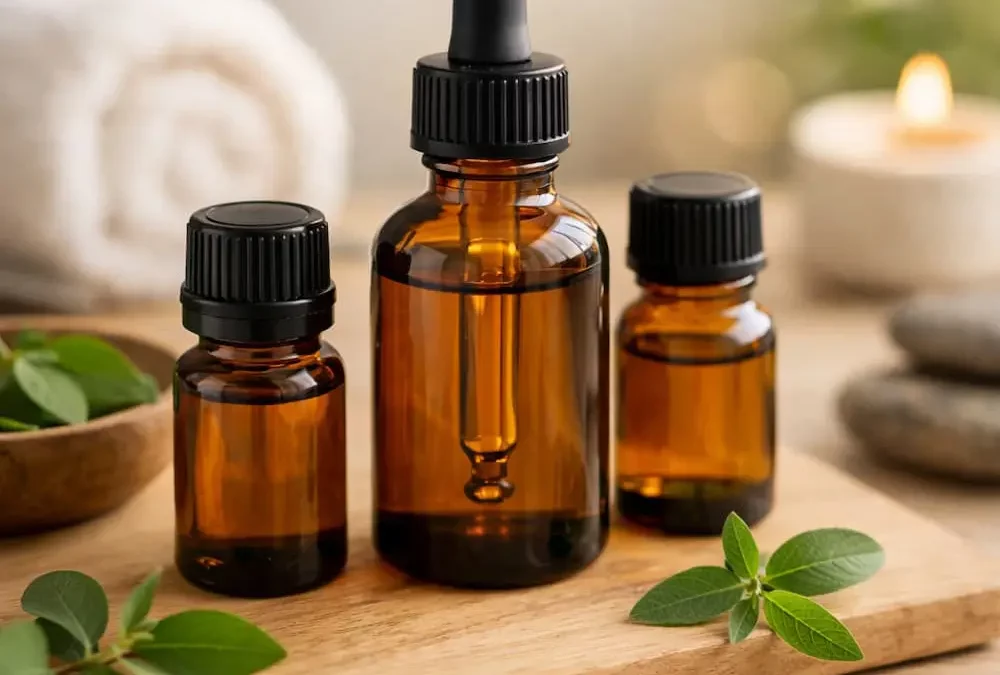
Using essential oils correctly: the essential guide for safe, informed and harmonious use
Essential oils fascinate with their aromatic potency, their naturalness, and their ability to transform an atmosphere or a skincare ritual. But their strength is also their limitation: concentrated, active, and sometimes irritating or photosensitizing, they require informed use.
This guide brings together the essential principles to fully enjoy their benefits… safely.
1. What is an essential oil ?
An essential oil is an aromatic extract obtained from a plant—leaves, flowers, bark, resin, or peel—by steam distillation or cold pressing. Each bottle contains a exceptional concentration of active molecules, sometimes several hundred, which explains both their effectiveness and their potential for irritation.
They are neither perfumes, nor conventional cosmetics, nor over-the-counter medications : they are powerful natural substances, to be handled with respect.
2. Essential oils: what are they for ?
They can be used for :
-
Create an atmosphere (atmospheric diffusion)
-
To soothe or to energize (olfaction)
-
Supporting a wellness ritual (diluted massage)
-
Naturally perfume an interior, a linen, a bath
-
Accompanying relaxation or meditation
They are not a substitute for medical treatment and should never be used for self-diagnosis or self-treatment. Their role is well-being, not therapeutic.
3. The golden rules for safe use
• Always dilute on the skin
A pure essential oil can irritate, burn, or sensitize. It should be diluted in a vegetable oil (sweet almond, jojoba, fractionated coconut, etc.) :
- Face : 0.5 to 1%
- Body : 1 to 3%
- Localized areas : 3 to 5% maximum
• Never ingest without medical advice
Ingestion is the riskiest route: burns, interactions, liver toxicity. It has useless in a wellness context.
• Broadcast in moderation
10 to 15 minutes is enough to scent a room. Avoid continuous diffusion, which is unnecessary and irritating.
• Test before applying
A test in the crook of the elbow for 24 hours helps to avoid skin reactions.
• Protect children, pregnant women, and animals
Some oils are contraindicated: peppermint, eucalyptus globulus, camphor rosemary, cinnamon, clove… Gentle oils are preferred (fine lavender, Roman chamomile) and always in light diffusion.
4. Essential oils should be handled with care
Some oils are particularly potent and must be used with expertise :
-
cinnamon bark
-
Compact oregano
-
Savory
-
Clove
-
Thyme thymol
-
Wintergreen
-
Eucalyptus globulus
They are caustic to the skin, irritating, or potentially toxic in high doses. For wellness use, oils are preferred gentle, balanced, versatile.
5. The easiest essential oils to use
Fine lavender
Soothing, balancing, gentle on the skin (diluted).
Sweet orange
Comforting, ideal for diffusion.
Lemon
Purifying, luminous, perfect for creating ambiance (caution: photosensitivity on the skin).
Ylang-ylang
Sensual, enveloping, perfect for relaxation rituals.
Tea tree
Purifying, essential for targeted use (always diluted).
6. How to choose a quality essential oil
A premium essential oil should display :
- The latin name
- The chemotype (if relevant)
- Its geographical origin
- The distilled part
- The extraction method
- The lot number
- A chromatographic analysis available
A transparent bottle, without origin, without Latin name or without traceability, should be avoided.
7. The most common mistakes (and how to avoid them)
-
Apply a pure essential oil to the skin
-
Broadcast for too long
-
Mix several oils at random
-
Using essential oils on babies
-
Ingesting them without medical supervision
-
Apply them before sun exposure
-
Using them as a substitute for medical treatment
8. In summary : proper use means balance
Essential oils are aromatic treasures. They transform a home, soothe the mind, and enrich a ritual. But they require respect, moderation and knowledge.
When used correctly, they become a valuable ally for daily well-being. When used incorrectly, they can become irritating or dangerous.
The main point is simple : less is more. Always dilute. Always listen to your body. Always prioritize quality.